It’s 1944.
World War II is in its final throes. While the Allies are holding ground, they need more troops and local cooperation. The Office of Strategic Services (OSS, which is now known as the CIA) needs to cultivate resistance behind enemy lines, including “citizen saboteurs.” To make partisan acts of petty sabotage more accessible, they wanted to create an army of citizens waging war on governments by simply doing their job very badly. The strategy came in two parts: part one focused on functional sabotage (e.g. intentionally poor maintenance of government vehicles), while part two focused on “the human element.” The human element amplifies opportunities to make faulty decisions, foster a non-cooperative environment, and induce others to embrace the idea.
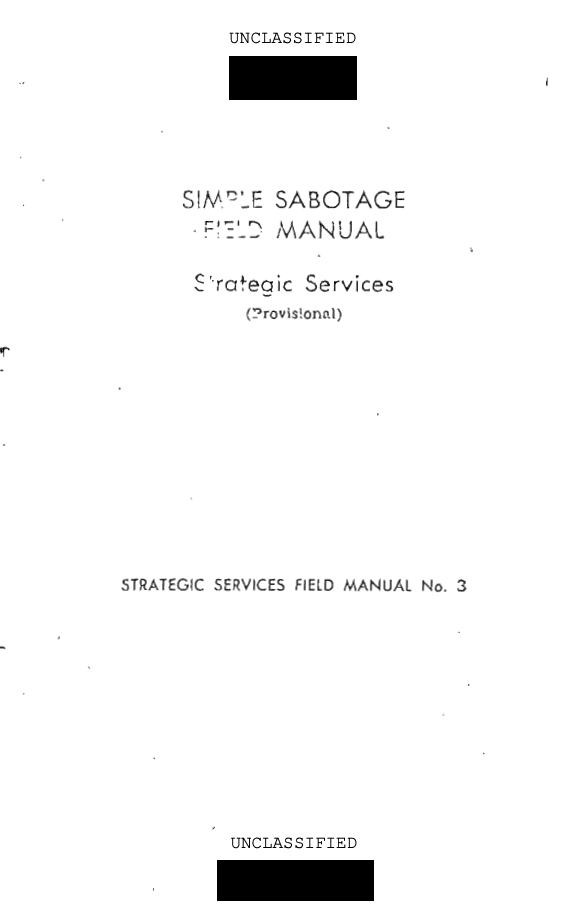
The strategy surfaced as the “Simple Sabotage Field Manual (Strategic Services Field Manual No. 3)” and was given to ground operatives to recruit and train citizens in occupied territory to commit simple acts of sabotage with minimal risk of being caught. Declassified by the CIA in 2008, these are the suggestions for bureaucratic sabotage:
Insist on doing everything through "channels." Never permit short-cuts to be taken in order to expedite decisions.
Make "speeches," Talk as frequently as possible and at great length. Illustrate your "points” by long anecdotes and accounts of personal experiences. Never hesitate to make a few appropriate “patriotic” comments
When possible, refer all matters to “committees”, for "further study and consideration." Attempt to make the committees as large as possible - never less than five.
Bring up irrelevant issues as frequently as possible.
Haggle over precise wordings of communications, minutes, resolutions.
Refer back to matters decided upon at the last meeting and attempt to re-open the question of the advisability of that decision
Advocate "caution." Be “reasonable” and urge your fellow-conferees to be "reasonable" and avoid haste which might result in embarrassments or difficulties later on.
Be worried about the propriety of any decision - raise the question of whether such action as is contemplated lies within the jurisdiction of the group or whether it might conflict with the policy of some higher echelon.
In the modern day
Do those suggestions remind you of any past meetings or discussions with your cross-functional peers?
“I think this works well, but I want to do some testing before we take this to leadership. I don’t think we have the right people in the room so I’m going to put together a tiger team dedicated to this so that we have buy-in from everyone else involved before we make a recommendation.”
“I don’t want to open this ‘can of worms’ again, but I think we need to revisit [any prior, unanimously agreed-upon decision] before we do anything else.”
“This doesn’t feel like a decision we can make alone, even if we feel really confident that we can deliver. I think this goes against the RACI and it’s really the responsibility of [any other team].”
If these sound familiar, I hope you also look at them differently now. The groan-worthy parts of today’s business culture are acts of simple sabotage. The seemingly innocuous elements we’ve all come to expect in our business communication have been studied, known sources of friction for over 80 years now.
It’s unlikely any saboteurs in your organization are intentionally trying to destroy the business in such petty ways. But, what can we do about these when they inevitably occur? Here are some recommended defenses against scenarios like these:
Always go through channels; never shortcut decisions. Raise jurisdiction concerns; defer to higher authority.
Enable autonomy at the lowest levels
Refer everything to large committees
Study team topologies to align to value streams
Make long speeches; tell irrelevant personal stories.
Avoid meeting culture; ask who really needs to be involved
Bring up irrelevant issues constantly. Haggle over exact wording.
If you must meet, keep it purposeful, agenda-driven, and time-bound
Reopen decisions already made
Keep a decision record
Urge caution and "reasonableness" to slow action
Craft organizational principles that define what “good enough” looks like so it can’t be weaponized.
I encourage you to share this article or the CIA field guide to your real-world collaborators. They’ll likely feel they’ve experienced these things first-hand, but may be shocked at its origins. The reality is that speed matters in business, and organizational drag is genuinely costly. Use these insights to build a work culture that can resist sabotage.
Thank you for reading.